Private Label Pet Care Product Packaging Guide: Bottles, Labels, and Buyer Checklist
A practical packaging guide for pet care brands covering container selection, label planning, transport protection, compliance information and pre-production checks.
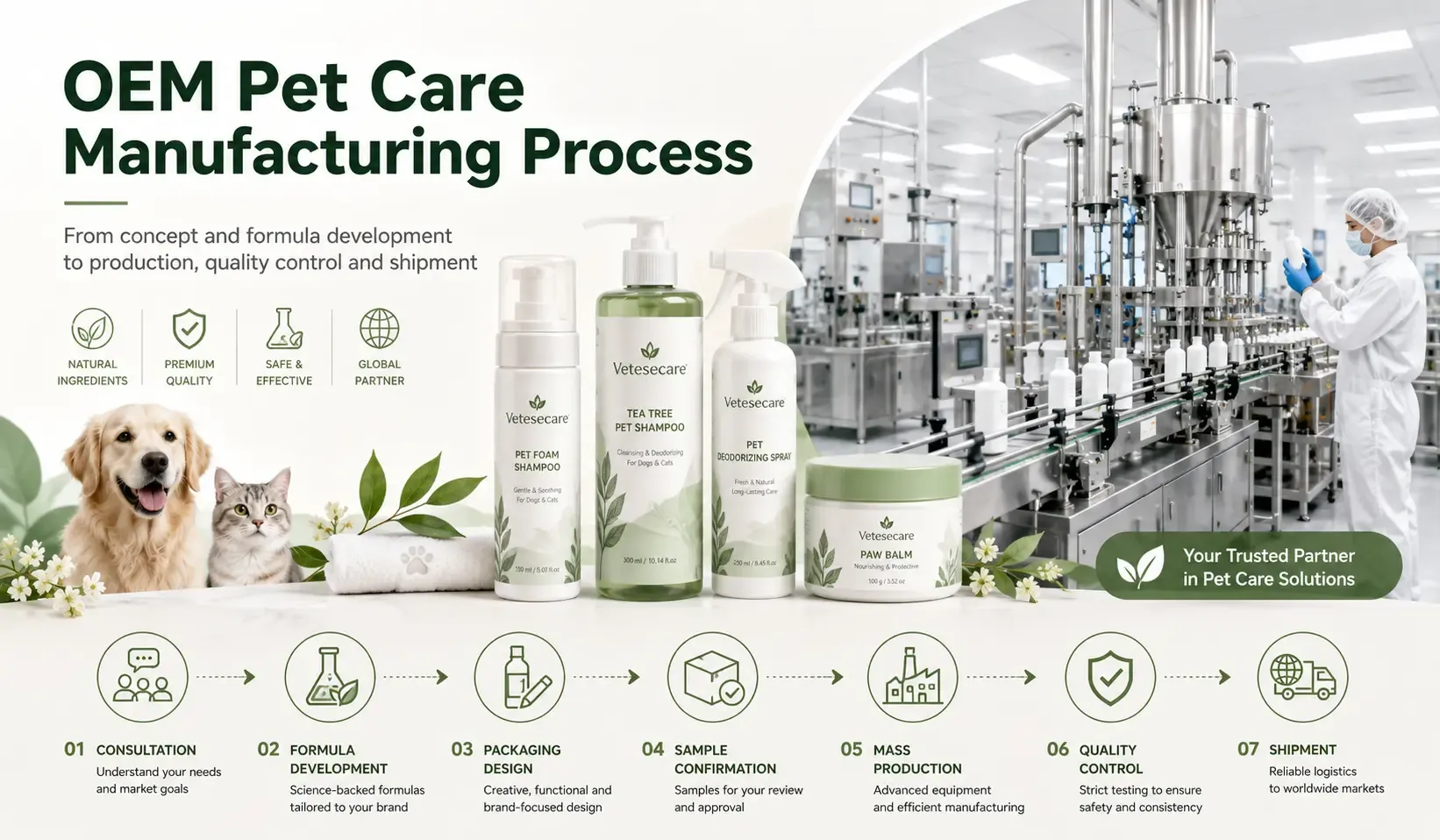
Packaging is one of the most visible parts of a private label pet care product, but its role goes far beyond appearance. The bottle, cap, label and carton must work together to protect the formula, communicate essential information and support efficient filling, shipping and retail display.
For pet shampoo, grooming sprays, cleaning foam and other hygiene products, a packaging decision made too late can increase costs or delay production. This guide explains what pet care brands, importers and distributors should review before approving packaging for an OEM or private label project.
Why Packaging Decisions Should Start Early
Formula, packaging and production are connected. A container that looks attractive in a rendering may not be suitable for the formula, filling process or distribution environment.
Early packaging planning helps buyers confirm compatibility, reserve space for required information, understand minimum order quantities, reduce leakage risks, estimate freight and avoid redesigning labels after samples are approved.
1. Select the Right Container Format
The product format and intended use should guide the choice of bottle, jar, tube or pouch. Consider how the consumer will hold, dispense and store the product.
- Pump bottles for shampoos and liquid cleansers.
- Trigger or fine-mist bottles for grooming and deodorizing sprays.
- Foaming pump bottles for mousses and waterless cleansers.
- Squeeze tubes for balms, creams and toothpaste.
- Dropper bottles for targeted liquid care products.
- Jars or twist-up containers for thicker formulas.
Confirm the fill volume, usable capacity, bottle dimensions and dispensing output. A package should be convenient for the product rather than selected only for its appearance.
2. Check Formula and Material Compatibility
Container material can interact with a formula over time. The manufacturer should review the selected bottle, closure, liner and dispensing system in relation to the product.
Ask whether the proposed packaging is suitable for the formula’s viscosity, pH, fragrance system and intended storage period. Compatibility testing may be appropriate for customized formulas or new packaging combinations.
3. Choose a Closure That Matches Product Use
The cap or pump affects convenience, dosage control and leakage protection. Review pump output, spray pattern, sealing method, resistance to accidental opening, bottle-neck compatibility and whether an inner seal or shrink band is required.
Test the complete package with the actual formula whenever possible. A closure that works with water may behave differently with a thick shampoo or foaming cleanser.
4. Plan the Label Before Finalizing the Bottle
The available label area can limit typography, translations and regulatory information. Measure the printable surface and identify curves, seams or textured areas that may affect adhesion.
A pet care label may need space for the product name, intended animal, net content, directions, warnings, storage instructions, ingredients, batch coding, responsible-company information, country of origin and barcode.
Exact requirements vary by product type and destination market. Buyers should confirm local rules with an appropriate regulatory professional before printing.
5. Keep Claims Clear and Supportable
Packaging claims should describe the product accurately and avoid unsupported medical or therapeutic promises. Terms such as gentle, deodorizing, daily care or for dogs and cats should match the formula, intended use and available documentation.
Review product names, benefit statements, icons and before-and-after language before final artwork approval.
6. Compare Label and Printing Methods
Common options include pressure-sensitive labels, shrink sleeves, screen printing and printed cartons. Compare minimum order quantity, artwork setup, color limitations, proofing, finish options, moisture resistance, application tolerances and lead time.
For a first order, a standard bottle with a high-quality label may offer more flexibility than fully customized molded packaging.
7. Design the Shipping Carton for Protection
Retail packaging must also survive storage and transportation. The outer carton should protect bottles from crushing, leakage and excessive movement.
Review units per carton, divider requirements, carton dimensions, gross weight and shipping marks. For pumps or triggers, confirm whether locking, protective collars or orientation controls are required.
8. Understand How Customization Affects MOQ
Packaging often determines the commercial minimum order quantity. A stock bottle may be available at a lower MOQ, while a custom color, mold or printed component can require a larger commitment.
Ask the manufacturer to separate the product filling MOQ, bottle and closure MOQ, label or carton printing MOQ, custom color or mold MOQ and remaining packaging inventory arrangements.
9. Approve Physical Samples and Final Artwork
Digital mockups are useful, but they do not replace physical review. Before mass production, check a complete sample representing the intended bottle, closure, label and formula.
Verify product name and spelling, label placement, colors, dispensing performance, leakage protection, batch-code area, barcode scan quality and carton fit. Record approval in writing and identify the exact artwork version and packaging specification.
10. Pre-Production Packaging Checklist
- The container and closure are compatible with the formula.
- Fill volume and package dimensions are correct.
- Label content has been reviewed for the destination market.
- Claims are accurate and supportable.
- Artwork files and colors are approved.
- Barcode and batch-code areas are usable.
- Retail units fit securely in the shipping carton.
- MOQ, lead time and packaging costs are documented.
- The approved sample matches the final specification.
Frequently Asked Questions
Should a new pet care brand use stock or custom packaging?
Stock packaging usually offers lower development complexity and may support smaller initial orders. Custom packaging can create stronger differentiation but often requires higher MOQs, longer lead times and additional testing.
What packaging is suitable for pet shampoo?
The best format depends on viscosity, fill volume and intended use. Pump or flip-top bottles are common, but the formula and closure should be tested together before production.
Who is responsible for label compliance?
The brand owner or importer should confirm the requirements of the destination market. An OEM manufacturer can provide product information, but local regulatory review may still be necessary.
Can packaging be changed after sample approval?
Changes may be possible, but they can affect cost, MOQ, compatibility, artwork and lead time. Any change should be documented and approved before mass production.
Build Your Private Label Pet Care Line With Vetesecare
Vetesecare supports OEM, ODM and private label cooperation for pet shampoos, grooming products and hygiene solutions. Packaging, label presentation and order requirements can be discussed according to the buyer’s product brief and target market.
Contact our team with your preferred product type, pack size, estimated quantity and destination market to begin a packaging and product discussion.